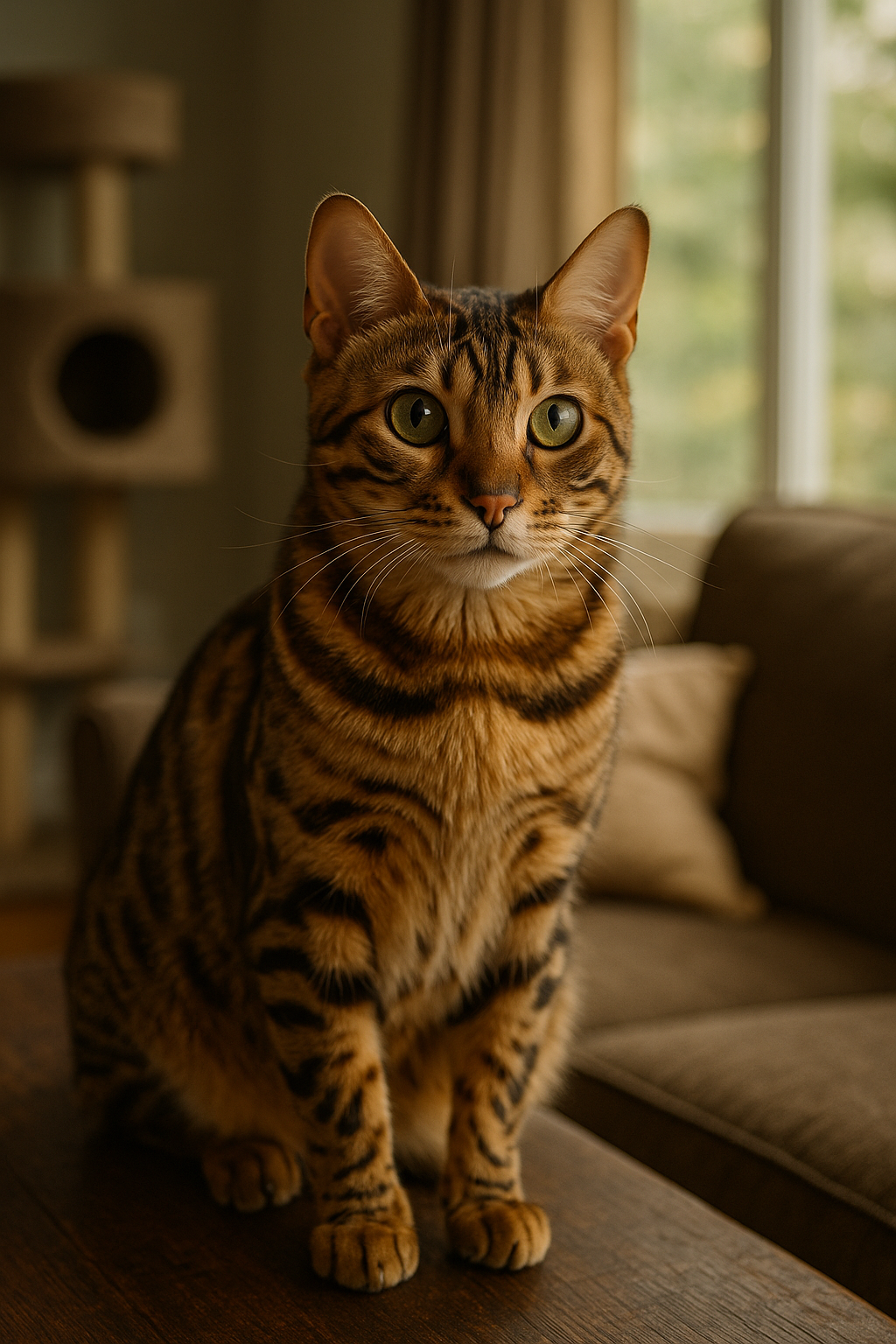
The Bengal cat is a fascinating hybrid resulting from the crossing of a black domestic cat and a wild Asian leopard cat (Prionailurus bengalensis), a small feline abundantly present in the Bengal province, in the east of the Indian subcontinent. This hybridization, initiated in the 1960s, gave birth to a unique domestic breed, combining the wild appearance of its ancestor with the sociability of the house cat.
Contents
- The 1960s, the origins of the pre-history of the Bengal cat
- The transition years leading to the official recognition of the Bengal breed
- The arrival of the Bengal breed in France
- The Bengal cat today
- Frequently Asked Questions (FAQ)
1. The 1960s: experimental origins
At the beginning of the 1960s, American geneticist Jean S. Mill brought in a female leopard cat from Asia, named Malaysia, and placed her in a secure enclosure. A few months later, she introduced a black male American Shorthair. In 1963, Malaysia gave birth to two hybrid kittens. One died shortly after birth, but the other, a female she named “Kin Kin,” survived and quickly showed a beautifully spotted coat as well as a character both curious and relatively docile. These first experiments laid the foundation for an unprecedented genetic program aimed at marrying the wild appearance of the Asian feline with the friendliness of the domestic cat.
2. The 1970s–1980s: towards a structured breed
In the 1970s, Dr. William Centerwall, a researcher at the University of Davis, became interested in the natural resistance of hybrid cats to feline leukemia. He created several lines of female ALC × domestic cats and entrusted eight of them to Jean Mill. She diversified her crossings by introducing Egyptian Maus, Abyssinians, Orientals, Siamese, and even British Shorthairs carrying the “silver tabby” gene. The goal was to stabilize the “spotted” and “marble” patterns while softening overly wild behaviors. After four generations (F4), the individuals obtained were fully fertile, balanced, and conformed to the first standards, giving rise to the Millwood breeding, renowned for the quality of its Bengals.
3. The arrival of the Bengal breed in France
The first Bengal imported into France was Lady Benji, in 1989, thanks to Odile Caillard-Arnoux from the Petit Poucet breeding. By 1993, the first French litter was born. In 1997, the LOOF officially recognized the breed, which sparked a real enthusiasm: there were then 1,153 births in 2010, 1,965 in 2012, and more than 3,000 in 2016. Ranked in the top 3 favorite breeds of the French, just behind the Maine Coon and the Sacred Birman, the Bengal won the hearts of breeders and families with its unique aesthetics and playful temperament.
4. The Bengal cat today
Today, the Bengal is appreciated for its athletic physique and spectacular coat — spotting and marbling in brown, silver, and snow colors — as well as for its social and lively character. The F4 lines and beyond guarantee perfectly socialized and fertile individuals. They are active, curious cats, often fond of water games, tall cat trees, and interactions with their owners. Despite its wild origins, the Bengal develops a strong bond with humans and adapts well to other animals if socialization is early.
5. Frequently Asked Questions (FAQ)
Q1. What is the average lifespan of a Bengal?
A Bengal lives on average between 12 and 16 years, provided it has quality food and regular veterinary care.
Q2. Is the Bengal suitable for an apartment environment?
Yes, provided vertical structures (cat trees, secure shelves) and daily play sessions are offered to satisfy its need for activity.
Q3. What specific care is needed for its coat?
The Bengal’s coat is short and shiny. Weekly brushing is sufficient, or even twice a week during shedding periods, to remove dead hair.
Q4. Is the Bengal suitable for children and other animals?
Well socialized from a young age, the Bengal generally gets along very well with children and other animals. Its curiosity and energy make it an ideal companion for active households.
Q5. What are the maintenance costs?
Beyond the purchase price, expect €30–50 per month for high-end food, €100–200 per year for veterinary care, and possibly boarding fees in case of absence.
Also read:
- Complete guide on the Bengal cat
- Adopting a Bengal cat: prices and advice
- Health and reproduction of the Bengal cat